SCM Analysis
Detailing
| Vehicle: | 1964 Ferrari 250 LM |
| Years Produced: | 1964–65 |
| Number Produced: | 32 |
| SCM Valuation: | $9,802,000–$16,735,000 |
| Tune Up Cost: | $3,500-plus |
| Chassis Number Location: | On a plate welded to the frame in the engine compartment |
| Engine Number Location: | Stamped on a lug on the right rear of the engine |
| Club Info: | Ferrari Club of America |
| Website: | http://www.ferrariclubofamerica.org |
| Alternatives: | 1955 Jaguar D-type, 1995 McLaren F1, 1962 Ferrari 250 GT California Spider |
| Investment Grade: | A |
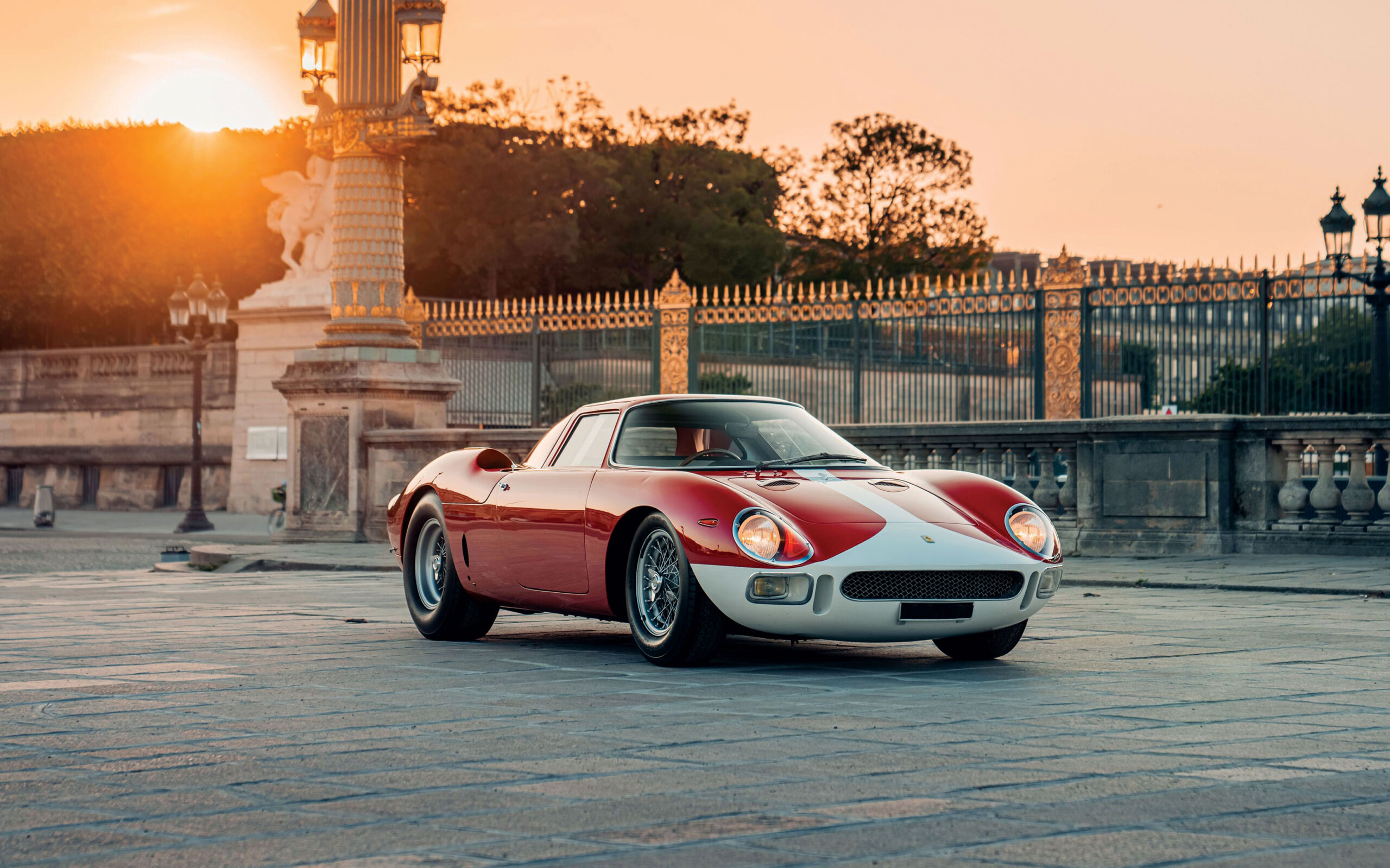
This car, Lot 1, sold for $17,189,031 (€15,771,200), including buyer’s premium, at Artcurial’s Paris, FRA, auction on July 6, 2023.
Bending the rules
“Never” and “always” are words that should be excluded from any Ferrari-related conversation. You may think you know your subject, but then Ferrari throws you a curve. Take the case of the 250 LM. Ferrari traditionally named a car for the displacement of one of its cylinders. Multiply the displacement of that cylinder by the total number of cylinders, and you have the full displacement of the motor. Multiply 250 cc times 12, and you would assume a 250 LM has a 3-liter motor. But that is wrong; a 250 LM has 275-cc cylinders, giving it a 3.3-liter V12 engine.
The discrepancy comes from Ferrari’s intended purpose for the 250 LM: GT racing. The Fédération Internationale de l’Automobile, or FIA, founded in 1904, is the governing body for much of international motorsports. One of its duties is to make rules for various racing series. In the past, a manufacturer needed to submit the specifications of a car it intended to race, and the FIA would examine the specifications and approve or deny the car for the intended series.
Detailed specifications were submitted on a form often known as homologation papers. The FIA assumed cars would be updated as they were raced, and it allowed some wiggle room for evolution. In a famous example, Ferrari’s 250 GT SWB homologation papers were updated and submitted with the specifications of an evolved 250 GT. In the application, the extension “Competizione,” as in 250 GT Competizione, was added to indicate this evolution. The papers were approved, apparently with little scrutiny, as the 250 GT Competizione had little resemblance to its predecessor. The FIA returned the papers minus the Competizione suffix, replacing it with an O for omologato, the Italian word for approved, or homologated. That car became known as the 250 GTO.
Middle management
In the early 1960s, it became clear that front-engine race cars were dinosaurs. Mid-engine cars were the future, but Enzo Ferrari resisted the trend, saying his preferred 12-cylinder engines were too large for mid-placement. He did, however, commission mid-engine Dino race cars to be built. The 6-cylinder 246 SP and 8-cylinder 248 SP Dinos proved the mid-engine concept, opening the door for a 12-cylinder car to be built.
The first mid-engine 12-cylinder Ferrari was the 250 P. It was built with a stretched version of the Dino SP chassis and a mid-mounted 250 engine built to GTO specs. The body was an open-top design with a full interior. Describing the car as successful would be an understatement. One example set a track record during a shakedown run, and another won the 1963 24 Hours of Le Mans, besting a 250 GTO.
Closed cars are more practical for endurance racing, and soon a closed version of the 250 P was built. Although the car was fitted with a 275 (3.3-liter) engine, it was called a 250 LM, indicating it was powered by a 3-liter engine. The ruse was an attempt to homologate the car as a further evolution of the 250 GT. Stung by letting the 250 GTO slip by proper homologation, the FIA took one look at the mid-engine configuration, 3.3-liter engine, and significantly different bodywork and promptly denied the LM for GT approval.
As a result, 250 LMs were relegated to racing in the prototype class, where they were a bit over their heads. A few folks tried to use an LM as an everyday car — not a promising idea, as the car was hot, the ventilation was marginal and the hard suspension bushings were designed for competition. Mostly, these cars retired to historic-racing and show duty.
From no-sale to good deal
Artcurial ran 250 LM s/n 5901 at its February Rétromobile auction. Overall, this was a strong sale, with a 72% sell-through and a pair of seven-figure results. But 250 LM s/n 5901 did not sell (SCM# 6956906), against a high bid of €20m ($21,874,000).
That number should have been more than enough to buy the car, and it turns out it was — just not on that day. Shortly after the aborted sale, Artcurial announced a July 7 auction at its Paris headquarters, with 250 LM s/n 5901 as the only lot. Something had changed, and the sale of the car became pressing. Artcurial did not publish an estimate the first time, so it was unusual that it did for the single-lot auction, including an estimate of €13,500,500–€20,000,000 in a new 48-page catalog. That’s right, the high estimate was the exact number Artcurial had reportedly turned down previously.
What happened at the first auction? Was the seller greedy? Did the phone lines go down? Why the car didn’t sell that day remains a mystery.
The auction of high-value automobiles is complicated and cutthroat. Full commission on a $20m sale would be in the $4m range. Auction houses fight fiercely for big cars, enticing sellers with flashy ad campaigns, minimum-sale guarantees, reduced commission, no commission and even a cut of the buyer’s commission. Auction houses may help a seller needing a bridge loan to buy another car. They may give buyers extra time to pay for their purchases. A lot goes on behind the scenes that we don’t see.
As for the car, it is rarer and faster than a 250 GTO. It is one of the most important cars on the planet and among the most valuable cars ever sold at auction. While this 250 LM does not have a competition pedigree, it is a well-known car with relatively clean history. The restoration is older, but the car still looks nice. Artcurial states that Ferrari Classiche certification is in process.
In the end, the buyer clearly got this trophy at a bit of a deal. ♦
(Introductory description courtesy of Artcurial.)